 Email: tung@thanhtin-tech.com


Thiết Bị Phân Tích Nhiệt Đồng Thời STA Series (Simultaneous Thermal Analysis) phân tích nhựa
Máy phân tích nhiệt trọng trường TGA phân tích mẫu nhựa (Thermal Gravimetric Analysis)
Máy phân tích nhiệt quét vi sai DSC 600 phân tích nhựa (Differential Scanning Calorimeters DSC 600)
Máy Đo Màu Chai PET Spectrophotometer UltraScan Vis
Máy quang phổ đo màu hạt nhựa ColorFlex L2
Máy đo màu nhựa MiniScan EZ 4000L
Máy quang phổ đo màu nhựa, ống nhựa Agera L2
Nhiệt lượng kế bom SDAC1000
Máy đo nhiệt trị SDAC1500
Máy đo nhiệt lượng bom oxy isoperibol tự động SDAC1200
Máy đo nhiệt trị (Nhiệt lượng kế) SDACM3200
STADI P Máy nhiểu xạ X phân tích đặc tính chất xúc tác hiệu quả về chi phí
STADIVARI Máy nhiễu xạ X dọc/ngang linh hoạt dành cho tinh thể/bột, chùm tia kép, X-AREA
STADI MP Máy nhiễu xạ đa hình học với nhiễu xạ vi mô, đầu dò đa năng, tùy chọn nhiệt độ.
Máy nhiễu xạ tia X di động Lattice GO
Máy phân tích nhiễu xạ tia X InSight (X-Ray Diffraction)
Thiết Bị Phân Tích Diện Tích Bề Mặt & Kích Thước Mao Quản Meso
Máy phân tích hấp thụ khí RuboSORP MSB
Máy đo tỷ trọng, thể tích và độ xốp vật liệu Densi 100
Thiết Bị Phân Tích Nhiệt Đồng Thời STA Series (Simultaneous Thermal Analysis)
Máy phân tích nhiệt trọng trường TGA Series (Thermal Gravimetric Analysis)
Máy phân tích nhiệt quét vi sai DSC 600 (Differential Scanning Calorimetry)
Nồi hấp quay (Rotary retort)
Máy tiệt trùng gia vị bằng hơi nước áp suất cao
Máy hấp tiệt trùng bằng hơi nước (Water immersion retort)
Máy hấp tiệt trùng bằng hơi nước (Water spray retort)
Nồi hấp tiệt trùng retort phòng thí nghiệm cho thực phẩm
Nồi hấp tiệt trùng retort phòng thí nghiệm cho đồ uống
ACA Permi - Hệ thống đo độ thấm khí và độ xốp theo thời gian thực
Máy quét độ xốp tự động trực tuyến ACA Scan – cho dữ liệu cuộn liên tục
Máy phân tích độ cứng cuộn tự động ACA RoQ Inline
Máy đo độ nhớt siêu cao ACA AX-100
Máy Phân Tích Khả Năng Giữ Nước ACA Flow WR để Tối Ưu Hóa Màu Phủ
Máy đo độ thấm khí ACA Permi Lab LP 100 / LP 300
Máy đo độ cứng cuộn giấy cầm tay ACA RoQ
Máy đo màu quang phổ MiniScan EZ 4500L cho ngành dệt may
Hệ thống đo màu in-line trong ngành dệt nhuộm SpectraTrend HT
Máy Quang Phổ Đo Màu UltraScan PRO cho ngành dệt may
Máy đo màu quang phổ Agera cho ngành dệt may
Máy Đo Màu Cà Phê hạt và bột Aeros
Máy đo màu nước cam, chanh, bưởi ColorFlex L2 Citrus
Máy đo màu bia Vista Spectrophotometer
Máy đo hoạt tính nước để bàn AwLab Plus
Máy đo hoạt tính nước cầm tay
Máy đo hoạt độ nước để bàn AwLab Plus
Máy đo hoạt độ nước cầm tay AWTESTER
Máy Rửa Chai Lọ Thủy Tinh (GMP washer) Poseidon 1200
Máy rửa dụng cụ thủy tinh bằng hơi nước axit Acid3600F
Máy rửa dụng cụ thủy tinh phòng thí nghiệm ngành thực phẩm
Máy Rửa Dụng Cụ Thủy Tinh Phòng Thí Nghiệm LW220H
Máy rửa dụng cụ thủy tinh phòng thí nghiệm LW230
Máy rửa dụng cụ thủy tinh phòng thí nghiệm LW320
Máy rửa dụng cụ thủy tinh phòng thí nghiệm LW190P
Kính hiển vi sinh học 2 mắt Optika B-159
Máy đo độ bền dung môi Biuged BGD 521 (1000±10 g)
MÁY ĐO ĐỘ BỀN VA ĐẬP MÀNG SƠN BGD-306
Máy Đo Độ Bền Va Đập Màng Sơn Biuged BGD 305
Máy đo độ bền màng sơn BGD 309
Máy đo độ bền màng sơn tự động Biuged BGD 310 (0.03mm-1.25mm)
Thiết bị kiểm tra độ bền va đập lớp phủ Biuged BGD 301 (50mm-500mm)
Thiết bị thử độ bền uốn của màng sơn BGD 564
Thiết Bị Kiểm Tra Bền Uốn Biuged Conical Mandrel Tester BGD 566
Máy kiểm tra độ bền uốn sơn T-Bend Tester BGD 568
Thiết bị đo tỷ lệ diện tích bong tróc lớp phủ BGD 350
MÁY KIỂM TRA ĐỘ BÁM DÍNH MÀNG SƠN TỰ ĐỘNG BGD 535 BUIGED
MÁY KIỂM TRA ĐỘ BÁM DÍNH MÀNG SƠN BGD 500/s BUIGED
Máy kiểm tra độ bám dính lớp phủ BGD 500
Thiết bị kiểm tra độ bám dính màng sơn Biuged BGD-502 Và BGD 504
MÁY ĐO ĐỘ CỨNG BÚT CHÌ TỰ ĐỘNG BGD507/S BIUGED
Máy đo độ chống mài mòn Mar Biuged BGD- 536
Máy kiểm tra độ trầy xước màng sơn BGD 520/2 hãng Biuged
Máy kiểm tra độ trầy xước bề mặt sơn tự động BGD 520/1 Biuged
Máy kiểm tra vết lõm Buckholz Biuged BGD 510 (500±5g)
Thiết bị đo độ cứng sơn bằng con lắc BGD 509/K+P BUIGED Trung Quốc
Thiết bị đo độ cứng màng sơn Biuged BGD 509S/P
Thiết bị đo độ cứng sơn bằng con lắc Biuged BGD 509S/K
Thiết bị đo độ cứng màng sơn Biuged BGD 505
Thiết bị đo độ cứng màng sơn Biuged BGD 506/4
Thiết bị đo độ cứng màng sơn Biuged BGD 506/3
Thiết bị đo độ cứng màng sơn Biuged BGD 506/2
Thiết bị đo độ cứng màng sơn Biuged BGD 506/1
Máy đo khối lượng sợi WYB:001
Máy kiểm tra số lượng sợi YCB:001
Máy đo độ căng của sợi dọc trong quá trình dệt - WARP TENSION METER
MÁY ĐO ĐỘ MỊN SỢI FFM:ELE2
Lab Calender Model LC-250
Laboratory soaping machine model SP-12
LEATHER DYEING APPARATUS
Laboratory centrifuge TS-1
COLOR WASHING FASTNESS TESTER (RAPID WASH)
PRINTING MASTER PM-500
AUTOMATIC WASHING MACHINE AW-12
Laboratory ROLL MILL
AUTO COATING DEVICE
LABORATORY MINI OVEN
Vertical type model P-AO
MINI TENTER
R-3
HT-Steamer H-TS-3
Máy rửa liên tục LAB WASHER
PAD STEAM processes with saturated steam PS-J
PAD STEAM processes with saturated steam PS-JS
MÁY NHUỘM LIÊN TỤC PHÒNG THÍ NGHIỆM PT-J
MÁY NHUỘM LIÊN TỤC PHÒNG THÍ NGHIỆM PT-V
Horizontal type model P-BO
P-TENTER
PMT-350 machine
MSP
Laboratory dosing system ROBOT DOSER
AUSTOCK PRO
Tủ nhuộm mẫu DYE CABINET
Hệ thống định lượng phòng thí nghiệm dệt nhuộm EZ-DOSER
Máy khuấy mẫu nhuộm JB-6
LAB COLOR KITCHEN CCK 40
Máy nhuộm mẫu ECO DYER
Máy nhuộm mẫu RAPID COLOR H TYPE
Máy nhuộm mẫu OSCI COLOR
Máy nhuộm liên tục phòng thí nghiệm MMC-30-3
Hệ thống nhuộm và hoàn thiện liên tục cho Lab MMC-30-4
Máy nhuộn hồng ngoại IR DYER
Máy nhuộm mẫu model RAPID COLOR HB TYPE
Máy nhuộm mẫu model ZY-1 KG DYER
Thiết bị ổn định nhiệt độ và độ ẩm (Máy điều hoà mẫu thì nghiệm) type 0
Máy kiểm tra độ đồng đều của sợi theo tiêu chuẩn ASTM D 2255
Máy đo độ đàn hồi sợi Elastometer 09X
Máy kiểm tra độ kín air proof vật liệu Dệt may Air proof 37SI
Tủ sấy vải nhanh phòng thí nghiệm Quick Drier 3
Thiết bị điều hòa nhiệt ẩm sợi nhanh ISO 139 TEX RAPID
Máy kiểm tra độ thấm khí Air permeability tester 37S
Thiết bị xác định số lượng sợi - Wrap reel 09 for yarn skeins preparation
Máy xác định số lượng sợi sliver - Sliver wrap reel 11S
Máy xác định khả năng chống thấm bề mặt vải Spray test 36
Máy kiểm tra độ bền màu giặt Washmeter 38
Máy kiểm tra độ mài mòn Abrasion Tester 66
Máy tạo mẫu đo màu sợi bán tự động Colour Sampling 74
Máy tạo mẫu đo màu sợi tự động Colour Sampling 74V
Máy đo độ căng sợi Tension meter
Máy đo giới hạn chống thấm nước của vải Water proof 35S
Máy đo độ thấm khí vải 37SC
Máy đo độ xoắn của sợi đơn và sợi đôi Twist-tester 17
Thiết bị kiểm tra độ hồi ẩm sợi dệt 70
Thiết bị kiểm tra độ cách nhiệt vải GESTER GT-CN08
Thiết bị phân tích bã cotton GESTER GT-B16A-1
Máy đo độ mịn sợi Gester GT-B17B
Tủ sấy kiểm tra độ hút ẩm vải bán tự động Gester GT-A37
Thiết bị kiểm tra độ bền màu sau giặt GESTER GT-C36
Máy tách mẫu phòng thí nghiệm GT-D39
Thiết bị kiểm tra bảo vệ nhiệt bức xạ nhiệt GT-C96
Thiết bị kiểm tra độ mài mòn Gester GT-C23
Máy đo độ dày vải GESTER GT-C46-2
Thiết bị kiểm tra độ đều của sợi và sợi mảnh GT-A14EH
Máy kiểm tra độ xù lông của sợi GT-A13
Máy kiểm tra độ bền sợi đơn và sợi tơ tự động GT-A05
Máy nhuộm Jigger phòng thí nghiệm GT-D27
Máy kiểm tra độ thấm hút của tã Gester GT-CN19
Máy kiểm tra độ đều sợi hoá học GESTER GT-A14C
Thiết bị kiểm tra độ bền màu của mực in GESTER GT-D12
Máy kiểm tra hệ số ma sát sợi GT-A32
Thiết bị đo lực căng sợi điện tử GESTER GT-A18
Máy đo nồng độ formaldehyde GESTER GT-C76
Máy kéo sợi Gester GT-AB19-12
Thiết bị kiểm tra độ mài mòn Gester GT-C20
Thiết bị kiểm tra lông tơ GESTER GT-C43C
Máy kiểm tra độ thấm nước Gester GT-CN07
Máy kiểm tra khả năng bắt lửa bề mặt vải GT-C37
Máy kiểm tra độ bền màu vải Gester GT-D02A-2
Máy kiểm tra đồ xù của vải GESTER GT-C18 - ICI Pilling and Snagging Tester
Máy kiểm tra độ bền màu khi cọ xát GT-D06 (Color Fastness to Rubbing Tester)
Máy kiểm tra độ mài mòn của vải GESTER GT-C17 ICI Mace Snagging Resistance Tester
Máy nhuộm mẫu nhiệt độ cao GT-D15
Máy nhuộm nhiệt độ phòng GT-D16
Máy cán là vải Gester GT-D19
Máy kiểm tra ma sát vải Gester GT-D45B
Thiết bị đo độ thẩm hơi nước vải GESTER GT-C28
Thiết đo độ thấm nước của vải GESTER GT-C31
Máy kiểm tra khả năng truyền hơi nước của vải GESTER GT-C28
Máy kiểm tra độ uốn De Mattia GT-C40
Máy kiểm tra độ mỏi đường may GT-C125
Thiết bị kiểm tra độ bền vải không dệt GESTER GT-CN01
Máy sấy quần áo Gester GT-D28
Thiết bị kiểm tra độ chống thấm nước vải Gester GT-C45
Máy đo độ xoắn sợi chỉ GESTER GT-A08
Máy kiểm tra giặt khô tự động GT-D59
Thiết bị kiểm tra độ rủ của vải Gester GT-C22
Thiết bị kiểm tra độ bền sợi vải GESTER GT-A02A-2
Máy kiểm tra độ đóng cục ngẫu nhiên GT-C19B
Máy đo độ bền Kéo cột đơn Gester GT-C02-1A (2.5KN)
Thiết bị kiểm tra độ bền kéo nén vạn năng GESTER GT-C01-1A
Máy kiểm tra độ thấm khí tự động GT-C27
Máy kiểm tra độ bục vải GESTER GT-C12A (Bursting Strength Tester)
Máy kiểm tra áp suất thủy tĩnh GT-C26A
Máy kiểm tra độ bền màu sau khi giặt Gester GT-D07
Máy kiểm tra độ co tự động của vải Wascator GT-D34
Máy kiểm tra độ bền thời tiết Gester GT-3000
Máy kiểm tra độ cháy góc 45° của vải GESTER GT-C32
Máy nhuộm mẫu hồng ngoại Gester GT-D22
Máy kiểm tra độ thấm nước Gester GT-CN04
Thiết bị kiểm tra độ kín vật liệu nhồi GESTER GT-C41
Máy cuộn sợi điện tử GESTER GT-A06-1
Thiết bị kiểm tra độ mềm vải Gester GT-CN05
Máy kiểm tra chống thấm lông vũ (Phương pháp kiểm tra va đập) GT-C42
Thiết bị kiểm tra độ kín vật liệu nhồi GESTER GT-C43B
Thiết bị kiểm tra độ bền xoắn dây kéo GESTER GT-C39B
Máy kiểm tra hiệu suất truyền chất lỏng cho hàng dệt may GT-C203
Máy kiểm tra độ đều sợi vải GESTER GT-A14HD
Máy Kiểm Tra Độ Rách Túi Đậu GT-C50
Máy đo độ mài mòn Gester GT-C87
Máy kiểm tra mật độ sợi vải Gester GT-C90-1
Máy kiểm tra mài mòn vải Gester GT-C15
Thiết bị cắt mẫu vải tròn đo định lượng GT-C75
Máy thử khả năng bắt cháy GESTER GT-C35B
Máy kiểm tra độ bền uốn vải nhiệt độ thấp GESTER GT-C47B
Máy kiểm tra độ kháng cháy của vải GESTER GT-C35
Thiết bị kiểm tra độ mài mòn vải Gester GT-C71
Thiết bị kiểm tra độ bền màu vải bằng Ozone Gester GT-D01B
Bộ dụng cụ thử mồ hôi trong dệt may Gester GT-D09
Máy đo độ bền bền màu vải Gester GT-D02A-1
Máy kiểm tra độ xù lông vải GT-C18
Máy kiểm tra độ lão hóa UV Gester GT-C29
Thiết bị kiểm tra độ thấm chất lỏng vải không dệt GESTER GT-CN02
Máy kiểm tra áp suất thủy tĩnh Gester GT-C26B
Máy kiểm tra độ bục vải GESTER GT-C12B
Máy test nút Gester GT-C09
Máy đo độ bền màu GT-D05
Máy kiểm tra độ bền màu ma sát GT-D04
Máy kiểm tra độ bền xé vải GESTER GT-C11B
Máy kiểm tra độ bền xé Elmendorf GT- C11A
Máy đo độ bụi bẩn dirty, stickies giấy tissue Micro-Scanner
Máy phân tích hình thành giấy Paper Perfect (PPF)
Máy phân loại màu hạt điều (dòng máy L Series)
Máy dò kim loại C-SCAN DLS
Máy tách kim loại RAPID PRO-SENSE
Máy dò kim loại C-SCAN GHF
Máy dò kim loại trong đường ống LIQUISCAN PL
Máy tách kim loại RAPID 5000
Máy dò tạp chất X-ray RayCon
Máy dò kim loại công nghiệp INTUITY
Máy quang phổ hấp thụ nguyên tử MGA-1000
Hệ thống điện di mao quản CAPEL-205
Máy phân tích thủy ngân trực tiếp RA-915 Lab
Máy quang phổ FTIR INFRALUM FT-08
Máy quang phổ hồng ngoại gần InfraLUM FT-12 Wholegrain
Máy đồng hóa áp suất cao, Homolab 2.20
Máy chiết siêu tới hạn dung tích 25L, 50L, 100L
Máy chiết siêu tới hạn dung tích 5L / 2x5L / 10L / 2x10L
Hệ thống kính hiển vi điện tử quét để bàn Cube II
Hệ thống kính hiển vi điện tử quét SEM Genesis-1000 với kích thước nhỏ gọn
Kính hiển vi điện tử SEM Normal SEM Genesis-2020
Bộ thu mẫu phân đoạn (Fraction Collector)
HỆ THỐNG SẮC KÝ LỎNG ĐIỀU CHẾ GRADIENT ECS12
HỆ THỐNG SẮC KÝ LỎNG ĐIỀU CHẾ ĐẲNG DÒNG ECS11
HỆ THỐNG SẮC KÝ LỎNG ĐIỀU CHẾ GRADIENT ECS10
HỆ THỐNG SẮC KÝ LỎNG GRADIENT ECS05
HỆ THỐNG SẮC KÝ LỎNG GRADIENT ECS04
HỆ THỐNG SẮC KÝ LỎNG ĐẲNG DÒNG ECS03
HỆ THỐNG SẮC KÝ LỎNG GRADIENT ECS02
Thiết bị kiểm tra chai thuốc lỏng trong suốt Apollo II
Hệ thống đo màu trực tuyến cho sản xuất bánh kẹo
Hệ thống đo màu trực tuyến (Inline) cho lớp phủ cuộn tôn màu HunterLab SpectraTrend HT
Hệ thống đo màu in-line trong ngành dệt nhuộm SpectraTrend HT
Máy quang phổ đo màu Cà chua ColorFlex L2 Tomato
Máy quang phổ đo màu cà phê ColorFlex Coffee
Máy quang phổ cận hồng ngoại NIR Visum Palm cho Thực Phẩm
Máy Đo Cấu Trúc Thực Phẩm X100-FTA
Máy đo độ ẩm giấy vụn AP 500 M6 Emco
Máy phân tích hấp phụ động BTSorb dòng 100
Hệ thống lò phản ứng BenchCAT cho ứng dụng nhiên liệu sinh học
Hệ thống lò phản ứng để bàn μBenchCAT
IPDS II / 2T Máy nhiễu xạ đơn tinh thể đáng tin cậy dành cho phân tử/protein, nền nhiễu thấp, 2θ 137°.
Nồi hấp tiệt trùng retort phòng thí nghiệm
Máy đo độ cứng cuộn giấy, màng nhựa cầm tay ACA RoQ
Máy đo hoạt độ nước để bàn AWLAB
Thiết bị kiểm tra độ hồi ẩm sợi dệt 70S
Thiết bị kiểm tra độ mài mòn và xù lông vải Gester GT-C13B
Máy kiểm tra độ xé vải GT-C10B
Máy phân tích chất lượng , kích thước xơ sợi bột giấy FQA-360
Máy Bắn Màu Cà Phê
Máy dò kim loại trong thực phẩm VARICON
Khúc xạ kế tự động hiện số RX-5000α-Bev
Máy quang phổ hồng ngoại gần model InfraLUM FT-12
Máy đồng hóa áp suất cao Homolab2.5
Máy chiết siêu tới hạn quy mô phòng thí nghiệm
Kính hiển vi SEM độ phân giải cao Veritas-LaB6
HỆ THỐNG SẮC KÝ LỎNG GRADIENT ECS01
Hệ thống sắc ký điều chế 250 ML/MIN, TOY18DAD800
Hệ thống sắc ký điều chế 50 ML/MIN, TOY18DAD800
Thiết bị kiểm tra chai thuốc lỏng màu Apollo II High Intensity
Hệ thống đo màu in-line trong sản xuất giấy SpectraTrend HT
Dịch vụ cho thuê thiết bị & Đo thuê
Máy quang phổ cận hồng ngoại NIR Visum Palm
Giải Pháp Đo Màu Cho Sản Xuất Nhựa SpectraTrend® HT
Thiết bị đo tỉ trọng khối của bột loại Scott Volumeter, Hãng Copley/Anh
Máy đo độ rã loại DTG-300i, Hãng Copley/Anh
Máy đo độ mài mòn loại Friabimat SA-400, Hãng Copley/Anh
Máy đo độ cứng loại TH3/200N, Hãng Copley/Anh
Máy đo sự lan truyền vết nứt nhanh ống nhựa Bayerteq RCP S4
Máy thử độ bền áp suất thuỷ tĩnh ống nhựa HPM XV Series
Máy đo độ bền áp suất thuỷ tĩnh ống nhựa HMP XP series
Máy đo độ bền áp suất thuỷ tĩnh ống nhựa HPM 2B- series
Máy kiểm tra va đập với tải trọng rơi – Dòng BT FWS với động cơ servo
Máy đo độ bền va đập ống nhựa UL651
Máy kiểm tra va đập ống nhựa - với công nghệ chân không FWV 3000-630B – vacuum
Máy kiểm tra va đập Charpy / IZOD
Máy kiểm tra chu kỳ nhiệt
Leak Tightness Tester
Thiết bị đo nhiệt hoá mềm Vicat/HDT
Khúc Xạ Kế Đo Độ Mặn Điện Tử Hiện Số PAL-SALT Atago
Khúc xạ kế đo độ ngọt điện tử Atago PAL ALPHA
Khúc xạ kế đo độ mặn điện tử Atago PAL Fish Tank
Khúc Xạ Kế Đo Độ Ngọt Điện Tử PAL-3 Atago
Khúc Xạ Kế Đo Độ Ngọt Điện Tử – Atago PAL-2
Khúc xạ Kế Đo Độ Ngọt Điện Tử – Atago PAL-1
Thiết bị phân tích huỳnh quang tia X MESA-50
Máy quang phổ đo màu ColorFlex L2
Máy dập mẫu INTERSCIENCE Bagmixer 400 W
Máy kiểm tra độ mềm giấy PN-RT1000F
Máy Đo Độ Trắng Giấy PN-48BF
Máy đo độ bền tách lớp giấy PN-IBTF chuẩn GB/T 26203, TAPPI T-569
Máy kiểm độ bền tách lớp giấy và bìa giấy X100-ZDT chuẩn TAPPI T541 hoặc ISO 15754
Máy Đo Độ Bền Kéo Xơ Sợi Đơn X100-FT chuẩn BS EN ISO 5079 và BS 3411
Máy Đo Độ Bền Kéo Giấy Tissue X100-TT
Máy đo màu thực phẩm MiniScan EZ 4500L
Máy cấy mẫu tự động INTERSCIENCE easySpiral
Máy dập mẫu INTERSCIENCE Bagmixer 400 W
Máy đếm khuẩn lạc bằng tay INTERSCIENCE Scan 50
Máy đếm khuẩn lạc tự động Ultra HD INTERSCIENCE Scan 4000
Máy đo vòng kháng khuẩn INTERSCIENCE Scan 4000
Máy pha loãng và cân mẫu INTERSCIENCE DiluFlow 2 bơm, 3Kg
Máy phân phối môi trường INTERSCIENCE Flexipump Pro
Nồi hấp tiệt trùng SH-AC-100M
Nồi hấp tiệt trùng SH-AC-60M
Tủ cấy vi sinh SH-HD-900V
Tủ ấm vi sinh SH-CH-150G
Tủ ấm vi sinh SH-CH-54G
Tủ sấy đối lưu cưỡng bức SH-DO-149FGB
Tủ sấy đối lưu cưỡng bức SH-DO-54FGB
Lò nung 1200℃ SH-FU-14MG
Lò nung 1200℃ SH-FU-5MG
Máy lắc Vortex VM-01U
SpectraAlyzer GRAIN NEO
Máy Quang Phổ Cận Hồng Ngoại NIR SpectraAlyzer FOOD
Máy Quang Phổ Cận Hồng Ngoại NIR SpectraAlyzer MEAT
MÁY NIR SpectraAlyzer SPIRITS
Máy Quang Phổ Cận Hồng Ngoại NIR SpectraAlyzer SUGAR
MÁY NIR SpectraAlyzer TEXTILE
Máy NIR SpectraAlyzer WINE
Máy Quang Phổ Cận Hồng Ngoại SpectraAlyzer BRAUMEISTER
Máy Quang Phổ Cận Hồng Ngoại SpectraAlyzer CLINICAL
Máy Quang Phổ Cận Hồng Ngoại SpectraAlyzer DAIRY
Máy Quang Phổ Cận Hồng Ngoại SpectraAlyzer FLEX
Máy Quang Phổ Cận Hồng Ngoại SpectraAlyzer FLOUR
Thiết bị phân tích nguyên tố ECS 4024 “CLASSIC ANALYZER” CHNS-O
Thiết bị phân tích nguyên tố ECS 4010 CHNS-O
Máy phân tích đạm bằng phương pháp Dumas ESC 8060
Máy phân tích nguyên tố hữu cơ đặc biệt ECS 8024
Máy phân tích nguyên tố hữu cơ ECS 8022
Máy phân tích nguyên tố CHNS-O, lò đơn ESC 8040
Máy phân tích nguyên tố CHNS-O, lò đôi ESC 8020
Thiết bị kiểm tra va đập bằng con lắc của Ray-Ran
Thiết bị vi xử lí đo lường độ tan chảy Ray-Ran MFR300
Thiết bị vi xử lý đo lường chỉ số tan chảy Ray-Ran MFR200
Máy kiểm tra độ bền kéo Testometric XFS
Máy kiểm tra độ nén hộp X350BC, X500BC
Máy kiểm tra độ bền kéo Testometric X500
Máy kiểm tra độ bền kéo Testometric X350
Máy Đo Độ Bền Kéo X250
Máy Đo Độ Bền Kéo Universal Testing Machine X100
Máy Đo Lực Nén Sóng Giấy PN-SMT250F S-Test Medium Crush Tester
Máy Đo Bề Dày Giấy Thickness Tester PN-PT6
Máy Ép Mẫu Giấy Xeo PN-PL8A Pneumatic Sheet Press
Máy Đo Độ Bền Mực In PN-PIDF ink rub tester
Máy Đo Độ Trắng Giấy Brightness Tester PN-48BF
Máy Đo Độ Cứng Giấy Crease Stiffness Tester PN-CSTF
Máy Đo Độ Bóng Giấy Glossiness Tester PN-GM
Máy Đo Màu Giấy Tissue PN-48AF Automatic Color Tester
Máy đo độ nghiền bột giấy CFS PN-PL26
Thiết bị cắt mẫu giấy đo độ bền kéo PN-TPC15
Thiết bị cắt mẫu đo nén cạnh giấy PN-ECC25
Thiết bị cắt mẫu đo nén phẵng FCT bìa carton
Thiết bị cắt mẫu đo định lượng giấy PN-SC100
Thiết bị kiểm tra tỷ lệ rơi bột mịn của khăn giấy PN-DQT
Thiết bị nấu bột giấy dùng thử nghiệm PN-PL1 Laboratory Rotary Digester
Máy đo bể dày giấy tissue tự động PN-PT12F Tissue Paper Thickness Tester
Máy nghiền Hà Lan PN-PL4 Valley Beater
Máy chế tạo mẫu dùng đo độ nén sóng giấy PN-MF Medium Fluter
Thiết bị đo độ giản ướt của giấy emco NDT 100-S Wet Expansion Tester
Máy đo độ nhẵn giấy Bekk emco GPR
Máy đo độ bền liên kết lớp giấy emco IBT
Máy đo độ ẩm giấy cuộn emco MP 5
Máy đo độ ẩm bột giấy CMM
Máy kiểm tra chất lượng in của giấy IAS Emco
Hệ thống kiểm tra giấy tự động emco PPA
Máy đo độ ẩm giấy phế AP 500-M2
Dịch vụ chuẩn đoán và sửa chữa
Dịch vụ hiệu chuẩn
Máy quang phổ đo màu Vista-ER
Máy đo màu MiniScan EZ 4000L
Máy đo màu quang phổ Agera
Dịch vụ bảo dưỡng
Máy đo độ co màng bao bì RSY-R2 Film Free Shrink Tester
Máy kiểm tra lực kéo XLW (PC) Auto Tensile Tester
Máy đo lực kéo C610M Labthink Auto Tensile Tester
Máy đo độ bền kéo tự động C610H Labthink Auto Tensile Tester
Máy đo độ thẩm thấu khí Labthink C130H Gas Permeability Tester
Máy kiểm tra tốc độ thẩm thấu khí Labthink C101B Gas Permeability Test System
Máy đo độ thẩm thấu khí BTY-B3P Gas Permeability Tester
Máy đo độ thẩm thấu hơi nước, WVTR, C306H Water Vapor Transmission Rate Test System
Máy kiểm tra độ thẩm thấu hơi nước, WVTR C390H Water Vapor Transmission Rate Test System
Máy kiểm tra độ thẩm thấu Oxygen, OTR C201B Oxygen Transmission Rate Test System
Máy đo tốc độ thẩm thấu Oxygen, OTR C206H Oxygen Transmission Rate Test System
Máy đo tốc độ thẩm thấu khí oxy, OTR C230H Oxygen Transmission Rate Tester
Máy đo độ thẩm thấu Oxygen C203H Oxygen Transmission Rate Tester
Máy kiểm tra nhiệt hàn dán bao bì Gradient C630H Heat Seal Tester
Máy kiểm tra hàn dán nhiệt HST-H3 Heat Seal Tester
Máy kiểm tra độ kín bao bì, độ bền hàn dán C660B Leak and Seal Strength Tester
Máy kiểm tra độ kín bao bì MFY-01 Leak Tester
Máy đo hệ số ma sát (COF), đo độ bám dính C620H
Máy đo hệ số ma sát MXD-02
Hệ thống đo màu online cPat Hunterlab
Hệ thống đo màu online SpectraTrend HT (In-Line and In-Process Spectrophotometers)
Máy Đo Màu Quang Phổ Spectrophotometer Vista-ER
Máy Đo Màu Quang Phổ Spectrophotometer UltraScan Vis
Máy Đo Màu Quang Phổ ColorFlex EZ Citrus Spectrophotometer
Máy Quang Phổ Đo Màu Aeros
Máy Đo Màu Quang Phổ ColorFlex EZ Spectrophotometer
Máy Đo Màu Cho Cà Phê ColorFlex EZ Coffee
Máy đo màu quang phổ MiniScan EZ 4500L
Máy đo độ bục giấy tự động PN-BSM160F
Máy đo độ bền kéo nén vạn năng 2000kN QC-952
Máy đo độ bền va đập Izod Charpy QC-639R/U
Máy Quang Phổ Đo Màu UltraScan PRO
Thiết bị kiểm tra momen lực JY-20N Digital Torque Tester
Máy đo độ bền va đập BMC-B1 Falling Dart Impact Tester
Máy đo độ bền va đập con lắc Labthink FIT-01 Film Pendulum Impact Tester
Máy kiểm tra độ nén thùng Carton Labthink C611M Box Compression Tester
Máy đo độ thẩm thấu khí C106H Gas Permeability Test System
Thiết bị đo lực đóng mở nắp chai tự động C612M Digital Torque Tester
Máy kiểm tra độ hàn dán nóng C632M Hot tack Tester
Máy dò rò rỉ bao bì dược phẩm không phá hủy C690H Nondestructive Package Leak Detector
Máy đo độ bền va đập C670M Falling Dart Impact Tester
Máy đo độ bền mực in RT-01 Ink Rub Tester
Máy đo nồng độ oxy trong bao bì C650M Headspace Gas Analyzer
Máy Kiểm Tra Độ Bền Xé ELMENDORF C680M Tearing Tester
Máy đo độ dày C640 Thickness Tester
Thiết bị kiểm tra độ thẩm thấu hơi nước, WVTR W3/031 Water Vapor Transmission Rate Tester
Máy đo độ bục bìa giấy carton tự động PN-BSM600F
Máy đo bền gấp giấy MIT PN-NZ135
Máy đo độ nhẵn giấy Bekk PN-BSTF
Máy đo độ bền kéo giấy PN-TT300F
Máy đo độ nén vòng giấy Crush Tester PN-CT300F
Máy đo độ bền xé giấy Paper Tear Tester PN-TT1000F
MÁY ĐO ĐỘ NÉN THÙNG CARTON QC-121D2
Thiết bị ép mẫu nhựa Ray-Ran
Máy cắt rãnh động Ray-Ran
Máy Đo Bền Kéo Giấy Tissue Tự Động PN-HT300AF Auto-Horizontal Tensile Tester
Máy đo độ bền chịu nén ống lõi giấy PN-CT500F
Máy đo độ bền kéo giấy tissue PN-HT300F
Máy đo độ bền uốn giấy PN-ST500F
Máy đo độ bục giấy tissue theo phương pháp Ball Burst PN-BBTF
Máy đo độ nghiền bột giấy SR PN-SDJ100
Máy đo độ phân rả giấy vê sinh PN-DPT
Máy đo độ thấm nước bề mặt giấy Cobb PN-COBB
Thiết bị cắt mẫu giấy đo nén vòng giấy PN-RCC152
Máy tách sơ sợi bột giấy PN-PL10A Bauer Fiber Classifier
Máy xeo giấy thử nghiệm PN-PL6C Hand Sheet Former Rapid-Koethen
Máy xeo giấy thử nghiệm Tappi PN-PL6T Hand Sheet Former
Máy đo nhiệt độ hoá mềm Vicat QC-662B
Máy đo chỉ số chảy nhựa QC-652B/C/D/E
Máy đúc mẫu thí nghiệm cơ lý vật liệu QC-674A
Máy đo độ ẩm da thuộc LD2 LD3 Moisture Meter
Máy đo độ ẫm mùn cưa, gỗ dăm AD22-CMS22 Moisture measuring system
Máy đo độ ẩm bìa giấy, ống lõi giấy DM7-AL Moisture Meter
Máy đo độ ẩm giấy cầm tay AD4A Moisture Meter
Máy đo độ ẩm giấy cuộn PD1-AL Moisture Meter
Máy đo độ ẩm giấy cầm tay DM4A
Máy đo độ ẩm giấy vụn emco AP 500-M6 solution
Thiết bị xác định độ hấp thụ hoá chất của giấy emco DPM Dynamic Penetration Measurement
Máy thử khả năng chống thấm nước QC-317F
Máy thử độ rơi QC-113A loại khí nén
Máy đo độ bền nén thùng carton QC-121M2F
Máy Đo Độ Mềm Mại Giấy Lụa, Vải Không Dệt, Tả Trẻ Em TSA
Máy đo rò rỉ bao bì dược phẩm không phá hủy C690H Nondestructive Package Leak Detector
Máy đo độ khuếch tán của thuốc bán rắn loại HDT 1000, Hãng Copley/Anh
Thước cặp điện tử đo độ dày viên nén loại Tablet Thickness Test 700, Hãng Copley/Anh
Máy đo độ rã thuốc trứng loại VTT, Hãng Copley/Anh
Máy đo độ rã loại DTG-200i, Hãng Copley/Anh
Máy đo độ rã loại DTG-100i, Hãng Copley/Anh
Máy đo độ rã loại DTG-400i, Hãng Copley/Anh
Máy đo độ rã loại DTG 200i-IS, Hãng Copley/Anh
Máy đo độ hòa tan loại DIS-600i, Hãng Copley/Anh
Máy đo độ hòa tan loại DIS-800i, Hãng Copley/Anh
Máy đo độ mài mòn loại FRV-100i, Hãng Copley/Anh
Máy đo độ mài mòn loại FRV-200i, Hãng Copley/Anh
Máy đo độ cứng loại TBF-100i, Hãng Copley/Anh
Máy đo độ rã thuốc đặt loại SDT1000, hãng Copley/Anh
Thiết bị đo tỷ trọng hạt, bột loại JV-200i, hãng Copley/Anh
Thiết bị đo tỷ trọng hạt, bột loại JV-100i, hãng Copley/Anh
Máy đo độ cứng loại TH3/500N, Hãng Copley/Anh
Máy kéo thép thuỷ lực 1000kN QC-954
Máy thử độ bền va đập Izod Charpy QC-639V/W
Máy ép tạo mẫu thí nghiệm QC-677C
Máy Kiểm Tra Độ Mài Mòn Martindale QC-341
Máy đo độ bục tự động QC-116D
Máy đo độ bục giấy QC-116
Thiết Bị Cắt Mẫu Đo Định Lượng QC-PS
Máy đo độ bền gấp MIT QC-104H
Máy đo mật độ quang LS117 ( OD Tester )
Máy đo độ nhớt và kiểm soát độ nhớt mực in tự động

Hotline
0903.121.021


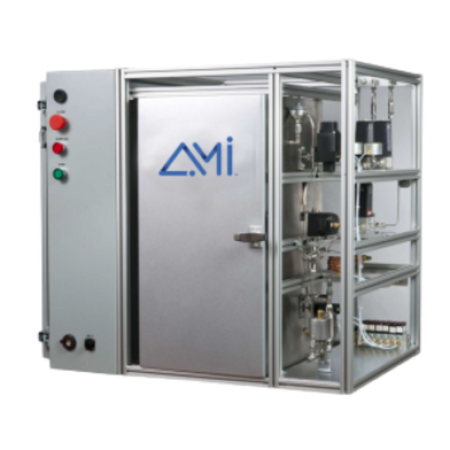
Hệ thống lò phản ứng để bàn μBenchCAT
-
213
-
Advanced measurement instruments (AMI) - Mỹ
-
Liên hệ
● Hỗ trợ tối đa 6 đường cấp khí và 2 đường cấp chất lỏng
● Lên đến 1200°C và 100 bar (có thể tùy chỉnh cho nhiệt độ cao hơn)
Introduction
The μBenchCAT by Advanced Measurement Instruments (AMI) is a fully integrated, benchtop reactor system designed for comprehensive catalytic studies. Engineered for both gas-phase and liquid-phase reactions, it combines all essential components into a compact, automated platform—ideal for academic, industrial, and R&D environments.
With a variety of configurable options, the μBenchCAT offers exceptional flexibility, making it suitable for a wide range of applications, from catalyst screening and reaction kinetics to long-term stability testing and performance evaluation under real-world conditions.
Features
Maximum Operating Temperature: up to 1200°C, depending on reactor material
Maximum Operating Pressure: up to 100bar
Gas Feed Capability: Up to 6 independently controlled gas feeds
Liquid Feed Options: Configurable for 0, 1, or 2 liquid feeds
Reactor Materials: Available in stainless steel, quartz, or Incoloy to suit a wide range of chemical and thermal environments
Wetted Materials: Durable and chemically resistant components including Stainless Steel, PEEK, Kalrez, Viton, Incoloy, and Quartz
Isothermal Oven: Houses key process components in a uniformly heated environment, minimizing thermal gradients
Multi-Station Capability: Optional Dual μBenchCAT configuration allows for two stations to operate in parallel or series, enabling simultaneous or sequential experiments for enhanced productivity
Full Automation: Controlled through a LabVIEW-based interface for precise operation of temperatures, flows, valve sequences, and reactions
Redundant Safety Systems: Multiple layers of protection, including temperature safety switches, pressure relief valves, positive shut-off valves, firmware-level alarms, and software-based user alarms, ensuring safe and reliable operation
Connection to External Detectors
The μBenchCAT provides seamless integration with external analytical instruments. The product effluent can be routed to a gas chromatograph (GC) or other detectors via an optional sampling valve, available in heated or unheated configurations. This capability enables real-time product analysis and greater experimental insight.
Built-In Safety Systems
Every μBenchCAT is designed with a robust suite of hardware, firmware, and software-level safety features to ensure safe operation under demanding experimental conditions:
• Check valves in all gas and liquid feed lines prevent backflow and cross-contamination.
• Software-coded alarms continuously monitor temperatures and pressures. These alarms are configured by AMI based on system safety limits.
•User-defined alarm matrix allows operators to set custom upper and lower limits for key process parameters and define actions if thresholds are exceeded.
Built-In Safety Systems (continued)
• Hardware over-temperature safety switch protects the furnace from overheating.
• Firmware-level alarms safeguard all heating elements.
• Preset pressure relief valves prevent system over-pressurization.
• Front-mounted power switch provides immediate power cutoff in case of an emergency.
• Double fusing is included in all 220 VAC process equipment for added electrical protection.
These layered safety features ensure that the μBenchCAT can be operated confidently in both routine and advanced catalytic studies.
Software
The μBenchCAT is fully automated to ensure ease of operation, process reliability, and repeatability. Designed for unattended operation, it allows users to configure experiments with minimal manual intervention. The operator simply inputs a sequence of process parameters and control steps, schedules a start time, and the system handles the rest.
All key functions—including valve positions, flow rates, temperatures, pressures, and product sampling—are automatically controlled by the system’s operating software. Data readback is performed at a user-defined sampling rate, and all data are saved in a text-delimited format for easy import into external software platforms for further analysis or reporting.
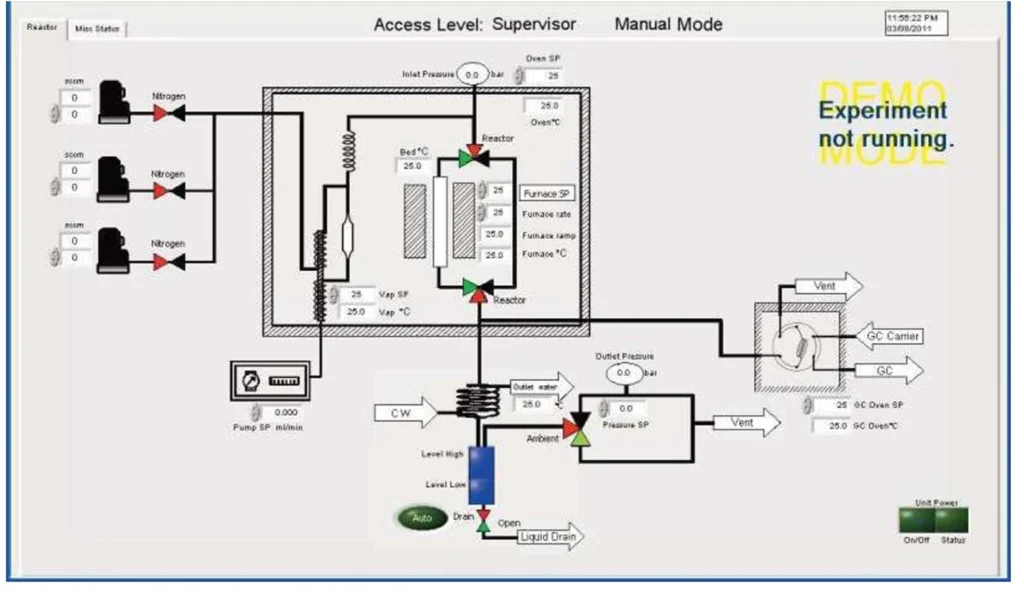
Control and data acquisition are managed through a dedicated LabVIEW-based application, developed specifically for the μBenchCAT. This software provides intuitive control logic, real-time visualization of system status, and complete experiment tracking, making the μBenchCAT a powerful tool for both routine and advanced catalytic research.
The μBenchCAT software includes three distinct user access levels, allowing controlled operation and protection of critical system settings:
• Locked-Out Mode: This mode is intended for security or safety scenarios where system access must be fully restricted. In this mode, no control actions or changes can be made until authorized login credentials are provided.
• Operator Mode: Designed for routine users, this mode allows access to day-to-day functions such as loading saved procedures, starting/stopping experiments, adjusting basic run parameters, and viewing real-time data. Critical system configurations and calibration settings remain protected.
• Supervisor Mode: This mode provides full access to all system settings, including calibration routines, gas configurations, user management, method creation/editing, and advanced diagnostics. It is intended for experienced users responsible for system setup, maintenance, and high-level customization
Applications
The μBenchCAT is engineered for high-performance catalytic testing in both gas- and liquid- phase environments. All core components are integrated into a compact, bench-top system, delivering precision, flexibility, and ease of use.
Reactor Feed System
The standard configuration supports up to 6 gas feeds and 2 liquid feeds. Each gas line includes a filter, electronic mass flow controller (MFC), check valve, and positive shut-off valve. The range and gas calibration of each MFC are specified by the customer to meet application requirements. Liquids are delivered via high-precision HPLC pumps (or liquid flow controllers), ensuring accurate and stable flow control.
Heated Isothermal Oven
An isothermal oven, operating up to 200°C, houses most process components to maintain a uniform thermal environment. This design minimizes condensation and ensures thermal stability throughout the system. Components located in the oven include:
• Integral gas preheater and liquid preheater/vaporizer, operable up to 300°C
• Feed mixer for combining gas and vapor streams
• Reactor by-pass valves for process flexibility
• Reactor furnace with control and safety thermocouples
• Reactor, equipped with an internal sample thermocouple for accurate temperature measurement
Condenser
A tube-in-tube condenser, located downstream of the reactor and outside the oven, ensures effective removal of condensable components. A thermocouple monitors the coolant return temperature, helping maintain thermal consistency and system stability.
Gas/Liquid Separator
Positioned after the condenser, the gas/liquid separator ensures efficient phase separation. Standard configuration includes high- and low-level switches to activate an automatic drain valve. An optional capacitance liquid level sensor is also available, offering continuous, precise liquid level monitoring for advanced level control and long-duration automation.
Pressure Control
Reactor exit pressure is measured via a dedicated pressure transducer. A high-turndown pressure control valve is used to build and regulate system pressure, enabling steady-state operation under pressurized conditions across a wide pressure range.
Product Sampling Valve (Optional)
An optional product sampling valve can route reactor effluent directly to an external analytical device, such as a gas chromatograph or mass spectrometer, enabling real-time product analysis and enhanced experimental insight.
BUILD A µBENCHCAT
| Category | Option | Code |
|---|---|---|
| A. Number of Gases | 0 | G0 |
| 1 | G1 | |
| 2 | G2 | |
| 3 | G3 | |
| 4 | G4 | |
| 5 | G5 | |
| 6 | G6 | |
| B. Number of Liquids | 0 | L0 |
| 1 | L1 | |
| 2 | L2 | |
| C. Pressure / Temperature | ATM / 1200°C | 0 |
| 50 bar / 650°C | 50 | |
| 100 bar / 650°C | 100 | |
| 100 bar / 800°C | 1008 | |
| D. Reactor OD | 0.25 in | 250 |
| 0.375 in | 375 | |
| 0.5 in | 500 | |
| 0.75 in | 750 | |
| E. Reactor Material | Quartz | Q |
| 316 Stainless Steel | S | |
| Inconel | I | |
| F. Gas / Liquid Separator | No | 00 |
| One Stage | 01 | |
| Two Stage | 02 | |
| Three Stage | 03 | |
| G. GC Sampling Line | None | 00 |
| Unheated After Pressure Reduction | 01 | |
| Heated slip-stream | 02 |
Tập tin PDF:
Tập tin PDF:

Hãng sx: Khác

Hãng sx: Khác

Hãng sx: Khác

Hãng sx: Khác

Hãng sx: Khác

Hãng sx: Khác

Hãng sx: Khác

Hãng sx: Khác

Hãng sx: Khác

Hãng sx: Khác

Thông tin liên hệ văn phòng


